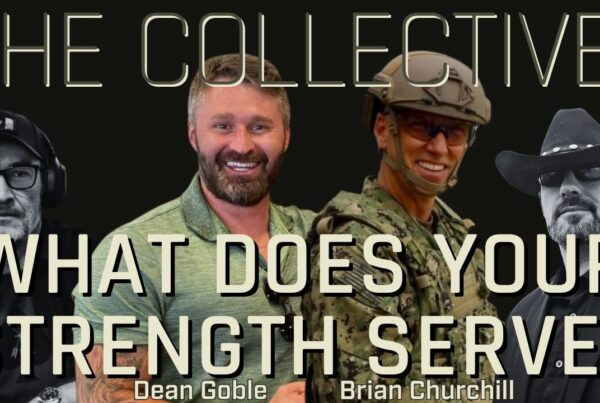

Is complexity a sign of sophistication, or insecurity? This week on The Collective, we explored the concept that Mastery is Reduction. Joined by Olympic lifting coach Greg Everett and mental skills coach Steve Gowin, we broke down the KISS principle (Keep It Simple, Stupid) and examined why elite performers obsess over fundamentals while amateurs get lost in the weeds.
This Week’s Panel:
– Greg Everett: Olympic Weightlifting Coach and author.
– Steve Gowin: Mental Skills Coach, retired Law Enforcement, and military veteran.
Key Insights from Our “Mastery is Reduction” Discussion:
1. Seeking Simplicity is Not Easy
Chance kicked us off with a vital reminder: Simple does not mean easy. Cleaning out your “mental garage”—stripping away the hoarding of ideas, habits, and ego—is simple in concept but difficult in execution. Complexity is often a hiding place; moving towards simplicity forces you to face the reality of the work.
2. The “Check Your Grip” Reset
Greg pointed out that when high-level performance starts to degrade, it’s rarely a complex issue—it’s usually a fundamental one. In shooting, it’s often as simple as “How’s your grip?” In lifting, it’s “How’s your posture?” Elite mastery isn’t about moving beyond fundamentals; it’s about maintaining a relentless, almost obsessive focus on them, even as the scenario becomes chaotic. When the wheels fall off, the answer is almost always found in the basics you learned on day one.
3. Pull the Reins, Don’t Push the Mule
Steve shared a coaching philosophy for dealing with eagerness: “I would rather pull the reins back on somebody than try to get them to go.” It is far easier to channel the chaotic energy of a passionate student into a focused direction than it is to manufacture drive in someone who doesn’t want to be there. Simplicity works best when harnessing existing momentum rather than creating it from scratch.
4. Use Your Own Failure to Build Trust
Steve noted that one of the simplest ways to reduce a student’s performance anxiety is to share your own failures. By humanizing himself and admitting, “Here is exactly where I messed this up,” he strips away the student’s need to be perfect. This removal of ego creates a simpler, more honest learning environment where the focus returns to the work, not the optics.
5. Humour as a Pattern Interrupt
Steve and Greg both highlighted the tactical use of humour. When a student is spiralling into overthinking, a well-timed joke or a question about their dog breaks the tension loop. It resets the brain, clears the “white noise,” and allows the body to take over the task again.
6. The “Psychic Hoarder”
Greg described all of us as “psychic hoarders”—we collect traumas, bad habits, and useless information until we can’t move. Mastery is the process of decluttering. It’s like Michelangelo carving David; you aren’t adding anything, you are chipping away everything that isn’t the masterpiece.
7. Pure Metal vs. Alloys
We discussed the metallurgy of character. While we seek “purity” in simplicity, I argued that we need some “impurities”—doubts, struggles, and friction—to create a robust alloy. A sword made of pure metal is too soft or too brittle. It’s the mixture of our simple core values with the complexity of our experiences that makes us durable.
8. Complexity is Built on Simple Blocks
Steve emphasized that you cannot understand complexity without first mastering the baseline fundamentals. He uses a layering approach: start with the absolute basics (stance, grip), and only once those are solidified, do you add the next layer of complexity. If a student gets lost in the weeds, the solution is always to strip away the complex layers and return to the fundamental building blocks until stability is restored.
Final Thought:
You don’t need more tactics; you need fewer distractions. Whether it’s lifting, shooting, or leading, the path to elite performance is paved with the ruthless elimination of the non-essential.
What can you subtract from your life today to get closer to the truth?
Listen to the full “Mastery is Reduction” discussion here: Mastery is Reduction
Keep simplifying,
Shaun & The Collective Crew