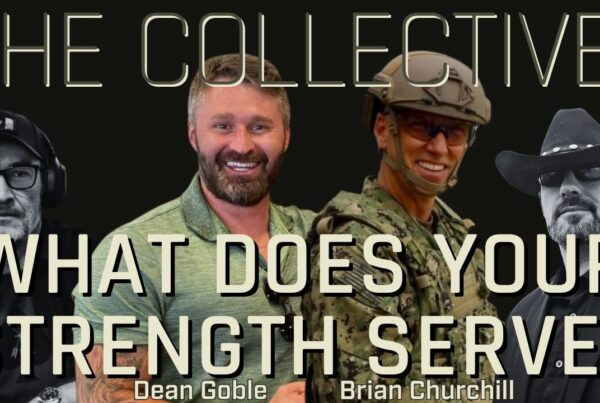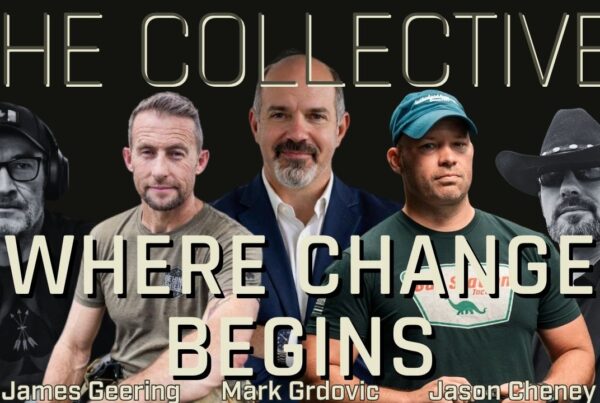
Hey Collective Crew, Shaun here. What happens to our vision when we are carrying an immense weight, be it physical, emotional, or psychological? On The Collective this week, an incredible panel – Jason “Jay” Cheney, Dr. Dan Allen, and Gordon “Gordo” Hurley – joined Chance and me for a raw and vital conversation on “Vision Under Load.”
We explored how service, trauma, and sustained pressure affect our ability to see clearly, both in the field and within ourselves, and how our perspective on past hardships evolves over time.
This Week’s Visionaries:
– Jason “Jay” Cheney: Police veteran and night vision specialist, sharing his recovery journey and the importance of having clear values.
– Dr. Dan Allen: Former NZ Army medic, MMA fighter, and clinical psychologist, providing insights on how stress and trauma alter perception.
– Gordon “Gordo” Hurley: Former Canadian Special Operator, and educator, discussing the performance mindset and the value of looking forward.
Key Insights from Our Vision Under Load Discussion:
1. Perspective on Hardship – The Evolving Definition of “Hard”
The conversation began by acknowledging that our perception of a “hard” experience changes dramatically over time. Dr. Dan Allen noted how his definition of hard evolved from basic training to harrowing experiences as a medic to the new challenges of fatherhood. It’s a reminder that our vision is constantly being recalibrated by our experiences.
2. The “Moment of Change” & The Calm in the Middle
Each panelist shared a pivotal moment where their vision instantly shifted, revealing a profound truth about leadership under pressure. In moments of extreme load – true chaos – formal hierarchies can dissolve in an instant. The group instinctively gravitates not necessarily to the designated rank, but to the “calm in the middle.” This is the individual who, through their presence and purposeful action, becomes a gravitational center for everyone else. My own experience as a young soldier at a mass casualty incident, where I simply began working on casualties, and Dr. Dan Allen’s story of triaging at a horrific motorbike accident, both illustrate this. People looked to us not because of our rank, but because we were demonstrating calm, effective action. This person who can “hold the space” becomes an anchor. Their vision, however taxed, remains functional, providing a beacon of clarity and direction that others can lock onto when their own perception has been shattered by chaos. It’s a primal human response to seek out and follow competence, not just authority, when survival is on the line.
3. Adversity Reveals Who You Are (and Who You Aren’t) – A Roadmap for Growth
Jay Cheney made the powerful and widely understood point that adversity reveals your true character. Building on that, I introduced a critical, often-overlooked, distinction: adversity doesn’t just show you who you are in that moment; it also clearly reveals who you aren’t. This “aren’t” is not a judgment or a final verdict of failure, but it is perhaps the most valuable piece of data you can receive. It exposes the gap between your current capabilities and your full potential. It’s in that space – the skills you lacked, the emotional regulation you couldn’t muster, the resilience that wasn’t quite there – that a clear roadmap for growth appears. Recognizing “who you aren’t” in a tough moment is the essential first step toward intentionally becoming the person you need to be for the next challenge.
4. Values as a Compass Under Load
Jay emphasized the importance of having a pre-established set of values as a “measuring stick” or compass when navigating stressful situations. When your values are clear, your decision-making process becomes more resilient, even when your vision is clouded by external or internal chaos.
5. The Weight We Carry – Auditing the Rucksack of a Past Life
The conversation turned to the immense, often unseen, “rucksack” of burdens we carry, and the critical skill of differentiating what is truly ours to bear. Gordo articulated this with profound honesty, providing a powerful lens through which to view the veteran experience. He described the common trap of carrying immense frustration towards large, impersonal institutions. This anger, while often justified, becomes a heavy, self-imposed load. As he pointed out, the institution isn’t losing sleep, but the individual is expending precious cognitive and emotional energy on a battle they cannot win – energy that could be applied to things they can influence.
This fixation on external frustrations often fuels what his buddies call the “shame spiral”: a cycle where dwelling on past grievances, perceived inadequacies, and the gap between who you were and who you are now, pulls you further down. This spiral is intensified by the weight of past identities. Gordo likened his relationship with his former military career to that of a “scorned lover” – something deeply loved and formative, but also a source of pain because it can never be fully recaptured. Clinging to that past identity, that “I was the man,” becomes a heavy, unproductive load that clouds the vision needed for the “what’s next?”
Learning to set down these specific weights – the unwinnable fight with an institution, the shame of not being who you once were, the ghost of a past love affair with a former life – is a critical act of self-preservation and clarity. It’s about auditing your own rucksack and consciously choosing to carry only what serves your forward momentum.
6. Letting Go of the Past & Living in the Present
I shared my personal experience with TBI-related memory gaps and how it ultimately became liberating, as the past is less of a concern, and to some degree unnecessary if I retain the broader wisdom gained along the way and acknowledge who I gained it from. In effect, this allows me to spend far more time in the present. Jay added his own path with his journaling practice, a system for getting future worries and past ruminations out of his head so he can focus on the now.
7. Self-Correcting vs. Self-Criticizing – The Internal Dialogue Under Load
Dr. Dan Allen introduced a pivotal distinction in how we process failure or mistakes under pressure: the difference between self-correction and self-criticism. Self-correction is an agentic, forward-looking process (“I need to adjust my hands on the weapon,” “My fitness protocol was wrong for this goal”). It’s a tactical adjustment based on new data. Self-criticism, however, is a toxic, backward-looking narrative (“I’m a bad person,” “I’ll never get this right,” “I’m broken”). Dan described how this negative internal story acts like a “handbrake on,” constantly dragging on your nervous system and preventing forward momentum. Learning to recognize and unhook from that critical inner voice and instead adopt a mindset of objective self-correction is a vital skill for maintaining clear vision and resilience when facing adversity.
8. The Agentic Path – Defining and Walking “The Way”
A powerful through-line in the conversation was the critical importance of personal agency. I spoke about the concept of “The Way” – not as a universal dogma, but as the unique path that each of us must define and walk for ourselves. The Way is the conscious act of taking control. While many factors influence our journey, the agentic individual doesn’t wait for permission or a perfect path to appear. They step up and declare, “This is my way,” and then align their actions to that conviction. It’s about moving from being a passenger in your own life to being the one at the helm, steering through adversity with a clear sense of internal direction and purpose.
I emphasized that despite the external forces that shape our lives, we must ultimately take the lead role in our own “movie.” Rejecting the passive narrative of being a victim to circumstances, institutions, or past labels. This agentic mindset means consciously choosing to steer your life in a direction that is positive and purposeful. It’s the understanding that while the world may try to shape you, you retain the power to “freaking shape it” right back. This isn’t about ignoring challenges, but about actively engaging with them, making the choices – however small – that move you towards the kickass, fulfilling life you want, not the one you feel has been handed to you.
Final Thought: Vision is a Skill, Tempered by Adversity, Leading to Internal Strength
Our ability to see clearly under load is not an innate gift; it’s a skill forged in the fires of adversity and honed through conscious practice. It requires deep self-knowledge, a clear set of values, the courage to let go of what isn’t ours to carry, and the fiery pursuit of your own agentic movie. The ultimate goal isn’t to avoid the load, but to develop the internal strength to carry it with clarity, purpose, and grace.
What weight are you carrying, and how is it affecting your vision?
Listen to the full “Vision Under Load” discussion here: Vision Under Load
Stay focused, stay present,
Shaun & The Collective Crew